
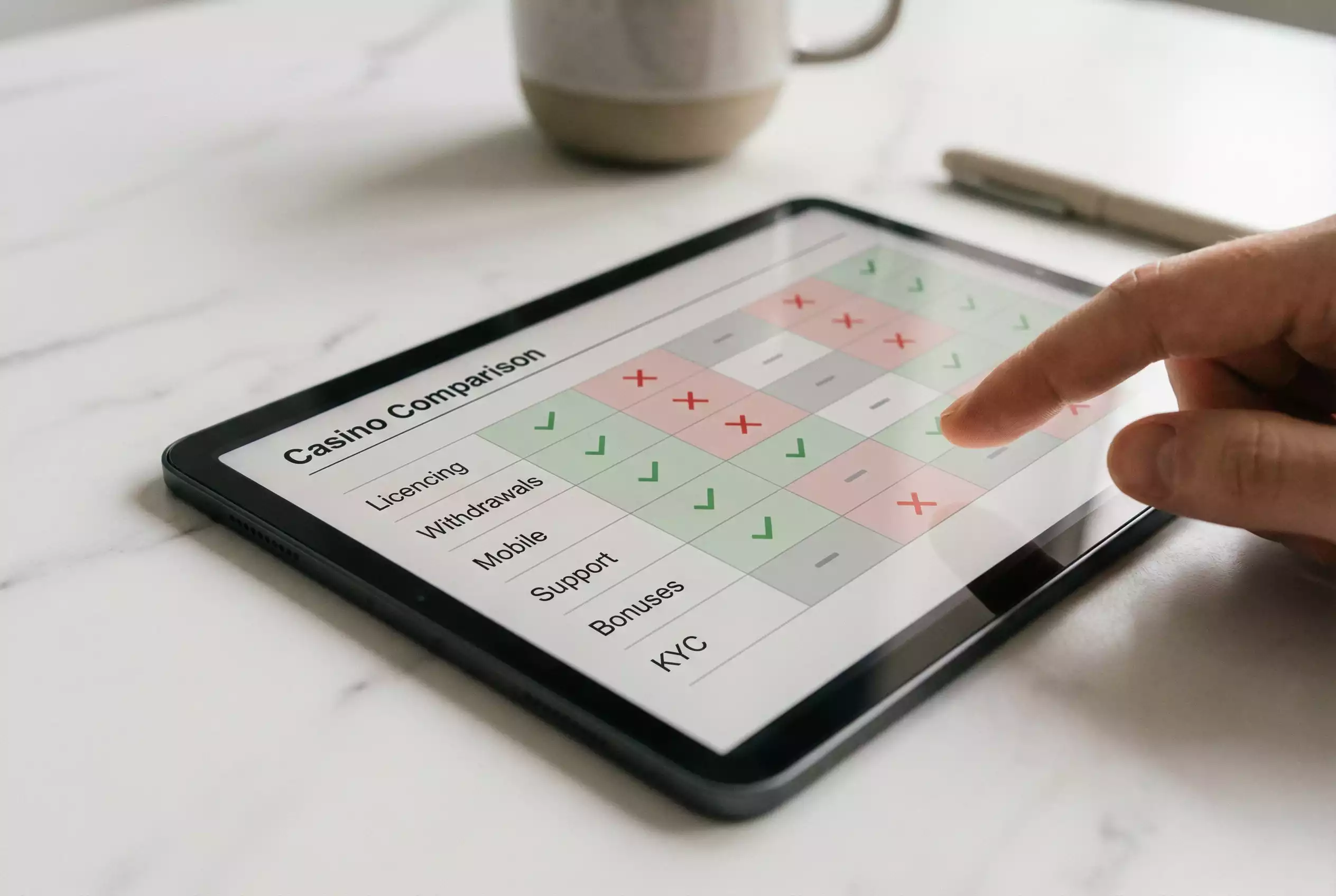
Why Comparison Tables Matter More at Non-GamStop Sites
Without a single regulator standardising everything, the differences between offshore casinos are larger. At UKGC-licensed casinos, the regulatory framework creates a baseline uniformity: all operators must segregate player funds, offer responsible gambling tools, participate in GamStop, and meet advertising standards. The differences between UKGC casinos are real but relatively narrow — bonus sizes vary, game libraries differ somewhat, and withdrawal speeds fluctuate within a constrained range. The regulatory floor keeps the worst outcomes off the table.
Non-GamStop casinos operate under varied licence frameworks with different compliance requirements. A Curacao-licensed casino and an MGA-licensed casino may both be described as “non-GamStop,” but their player protection infrastructure, dispute resolution mechanisms, and operational standards can differ dramatically. Beyond licensing, the variance extends to every aspect of the player experience: bonus generosity, wagering requirements, payment method availability, withdrawal processing times, game provider selection, and mobile optimisation quality. Two non-GamStop casinos can provide experiences so different that they barely belong in the same category.
This variance is why comparison is essential. At a UKGC casino, choosing the wrong operator costs you a suboptimal bonus or a slightly slower withdrawal. At a non-GamStop casino, choosing the wrong operator can cost you access to your funds, exposure to unfair game configurations, or a dispute resolution process that leads nowhere. Comparison tables — when constructed honestly and read critically — provide the structured information needed to differentiate between legitimate operators and those that exploit the regulatory latitude of the offshore market.
The challenge is that most comparison tables in the non-GamStop space are produced by affiliate sites with commercial interests that may not align with objective evaluation. Understanding both what to compare and how to interpret the comparisons is necessary for extracting genuine value from these resources.
What to Compare — The Categories That Actually Matter
Licence, bonus terms, game count, payment speed, mobile UX — in that priority order. Not every category carries equal weight, and the order in which you evaluate them reflects a practical hierarchy of importance for protecting your money and your experience.
Licensing jurisdiction is the foundation. A casino’s licence determines the regulatory framework it operates under, the enforcement mechanisms available if something goes wrong, and the minimum standards it must meet for player protection. Compare Curacao against MGA against Anjouan against Gibraltar — each jurisdiction provides different levels of oversight. An MGA licence indicates stricter compliance requirements than a Curacao sub-licence. A Gibraltar licence suggests a more established regulatory relationship than an Anjouan authorisation. The licence is not the only quality indicator, but it is the first filter: casinos with credible licences from jurisdictions that actually enforce their regulations are categorically safer than those with licences from jurisdictions that do not.
Bonus terms require granular comparison, not headline comparison. A table showing “Casino A: 500% bonus” and “Casino B: 200% bonus” is misleading if Casino A’s 500% comes with 60x wagering on bonus plus deposit while Casino B’s 200% comes with 25x wagering on bonus only. The meaningful comparison is the total wagering amount, the expected cost of completing that wagering, and the maximum cashout. Any comparison table that shows match percentages without wagering requirements is incomplete to the point of being useless for decision-making.
Game provider count and identity matter more than raw game count. A casino listing 5,000 games from unknown providers offers less value than one listing 2,000 games from Pragmatic Play, Evolution, NetEnt, Play’n GO, and Hacksaw Gaming. The provider names in a comparison table tell you about game fairness (are the RNGs independently certified?), game quality (are these providers known for polished mobile experiences?), and feature availability (do these providers offer the specific games and mechanics you want?). Raw game count without provider attribution is a vanity metric.
Payment method availability and withdrawal speed are practical categories that directly affect your experience. Compare which payment methods each casino supports (crypto, e-wallets, cards), the minimum and maximum deposit and withdrawal amounts, and the stated processing times for each method. Actual processing times often differ from stated ones, so cross-referencing comparison table data with player-reported experiences on forums adds a reality check that the table alone cannot provide.
Mobile UX is the hardest category to compare in table format because it is qualitative rather than quantitative. Some comparison tables include mobile ratings or scores, but these are subjective assessments by the table’s author. The most reliable way to evaluate mobile UX is to register with a small deposit and test the interface yourself — game load times, navigation intuitiveness, cashier accessibility, and live chat responsiveness on your specific device.
How to Read a Casino Comparison Table Critically
A comparison table is only useful if you know what the numbers mean. The format — rows of casinos, columns of features, colour-coded ratings — creates an impression of objectivity that the underlying data may not support. Reading a comparison table critically means questioning the data sources, the selection criteria, and the incentive structure behind the table’s creation.
Start with the source. Who created the table? If it is an affiliate site (and virtually all non-GamStop comparison tables are), every casino in the table is a commercial partner from which the site earns commissions. The casinos listed were not selected through a comprehensive evaluation of all available options — they were selected from the site’s affiliate portfolio. Casinos that do not offer affiliate programmes, or that offer lower commissions, may be absent regardless of their quality. The table compares the affiliate’s partners, not the entire market.
Check for completeness in each data column. A well-constructed comparison table shows wagering requirements alongside bonus amounts, licence jurisdictions alongside trust ratings, and actual withdrawal timeframes alongside stated ones. A table that shows only positive attributes — bonus size, game count, “rating: 4.8/5” — while omitting restrictive terms, licence details, and player complaint histories is designed to sell, not to inform. The missing columns often contain the information most relevant to your decision.
Question the rating methodology. Many comparison tables assign numerical ratings (out of 5 or out of 10) to each casino. If the methodology behind these ratings is not disclosed — what criteria were weighted, how scores were calculated, whether the ratings are based on testing or on self-reported data — the numbers are editorial opinions presented as objective measurements. A casino rated 4.9/5 by one affiliate site and 3.2/5 by another has not changed in quality between the two assessments; the rating reflects the reviewer’s criteria and incentives.
Look for variation. If every casino in a comparison table receives a rating above 4.0 and a recommendation, the table is not comparing — it is endorsing. A credible comparison includes casinos that score poorly on certain criteria, because the purpose of comparison is to reveal differences, including unfavourable ones. A table where every entry looks excellent is a marketing document, not an analytical tool.
Cross-reference key claims. If a table states that a casino processes withdrawals in under 24 hours, check player forums and review sites for withdrawal experience reports. If a table claims a casino offers 3,000 games, visit the casino and count the providers or check the game library filter. If a table lists a specific licence number, verify it against the licensing authority’s public database. Cross-referencing takes minutes per casino and converts table claims from assertions into verified facts.
Common Comparison Pitfalls — What Tables Don’t Show
Game count does not equal game quality. Bonus size does not equal bonus value. These are the two most common comparison pitfalls, and both exploit the tendency to equate bigger numbers with better outcomes.
A casino advertising 6,000 games may include thousands of titles from obscure providers with no independent certification, no published RTP data, and no player community recognition. A casino with 1,500 games from verified Tier-1 and mid-tier providers offers a library where every game has been independently tested and certified. Comparison tables that rank casinos by game count without qualifying the providers behind those counts mislead players into equating volume with reliability.
Bonus value is determined by the interaction of match percentage, wagering requirements, game contributions, maximum cashout, and expiry period — not by the match percentage alone. A 100% match with 20x wagering delivers more expected value than a 400% match with 55x wagering in virtually every scenario. Tables that sort casinos by bonus headline without incorporating wagering terms rank them by marketing spend rather than player return.
Withdrawal speed claims in comparison tables typically reflect the casino’s stated processing time, not the end-to-end experience. A casino that “processes withdrawals in 1 hour” may take an additional 24 to 72 hours for KYC verification on first withdrawals, plus the settlement time of the chosen payment method. The player’s actual experience — from clicking “withdraw” to receiving funds — may be three to five days, not one hour. Tables that do not distinguish between processing time and total receipt time create expectations that reality cannot meet.
Customer support quality is almost never represented accurately in comparison tables. A table might note “24/7 live chat: yes” without indicating whether the chat is staffed by knowledgeable agents or by bot-assisted responders who escalate every query to email. Support quality is experiential — it can only be assessed by interacting with it — and tables lack the format to convey the nuance that separates genuinely helpful support from technically available but practically useless assistance.
The Best Casino Is the One That Fits Your Priorities
No comparison table gives you the right answer. It gives you the right questions. The table narrows the field, highlights differences, and structures information in a way that unstructured browsing cannot match. But the final decision — which casino is right for you — depends on your specific priorities, and those priorities vary between players in ways that no universal ranking can capture.
A player who values live dealer gaming above all else prioritises Evolution availability and table limits. A player who plays high-volatility slots wants Hacksaw Gaming, Nolimit City, and unrestricted bonus buy. A player focused on fast crypto withdrawals prioritises payment processing speed and crypto support. A player concerned about safety weights the licence jurisdiction above everything else. Each of these players would rank the same set of casinos differently, and each ranking would be correct for that player’s priorities.
Use comparison tables as a starting tool, not a finishing one. Identify the casinos that score well on the criteria that matter to you. Cross-check the table’s claims against independent sources. Register with a small deposit and test the experience directly. The table tells you where to look. Your own experience tells you what you found. The best casino is not the one with the highest rating in a table. It is the one that consistently delivers the experience you value, at terms you understand, with reliability you can verify.