
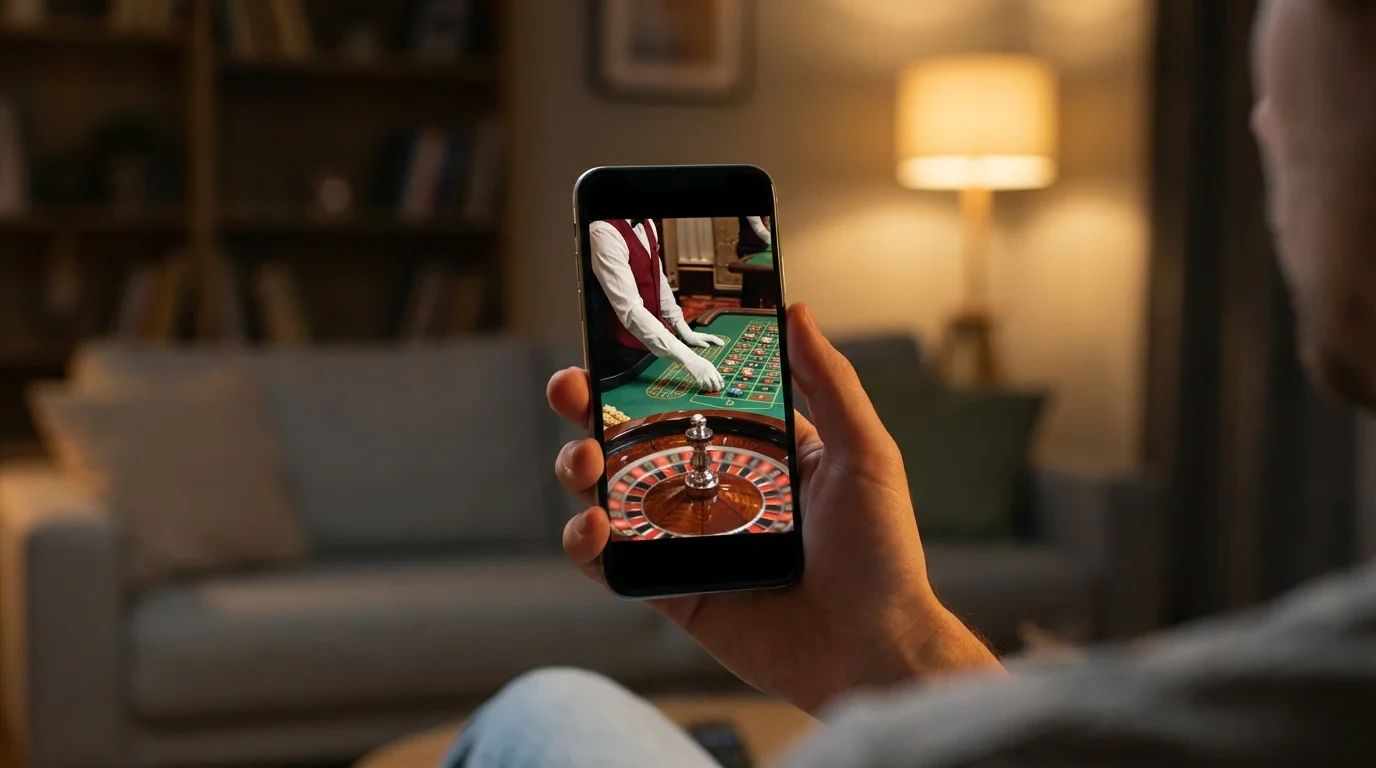
Live Dealer Gaming Was Built for Big Screens — Mobile Changed That
Live casino on a phone used to mean a laggy, cropped video feed with betting controls too small to hit accurately. That was the reality as recently as 2020, when most live dealer studios were still optimising their interfaces for desktop monitors and treating mobile as an afterthought. The transformation since then has been substantial, driven almost entirely by the fact that mobile now accounts for the majority of live casino sessions at non-GamStop platforms serving UK players.
The shift was not inevitable. Live dealer games stream video in real time from physical studios, which creates bandwidth and latency challenges that pre-recorded slots simply do not face. A slot operates on locally rendered graphics — the outcome is determined server-side, but the visual experience runs on your device. Live casino is fundamentally different. The video feed originates from a camera pointed at an actual table with an actual dealer, transmitted through encoding servers to your phone screen with a target latency of under two seconds. Every step in that chain — capture, encode, transmit, decode, display — needs to work smoothly for the experience to feel present rather than distant.
What made mobile live casino viable at non-GamStop casinos was a convergence of improvements. Studio providers redesigned their interfaces for portrait orientation, recognising that players hold phones vertically by default. Adaptive bitrate streaming became standard, automatically adjusting video quality based on connection speed so that a player on a congested 4G network sees a lower-resolution but stable feed rather than a high-resolution feed that buffers every few seconds. Touch-optimised betting controls replaced the mouse-targeted layouts of desktop versions. And the underlying streaming infrastructure — particularly the content delivery networks used by providers like Evolution — expanded to reduce latency for users across Europe, including the UK.
For UK players at non-GamStop casinos, mobile live dealer gaming now offers an experience that is meaningfully close to the desktop version. Not identical — screen size imposes constraints that no interface redesign can fully eliminate — but close enough that the vast majority of live casino play at offshore sites happens on phones. The remaining gaps are technical rather than conceptual, and understanding those gaps helps you set realistic expectations before joining a live table from your mobile device.
Evolution, Ezugi, Pragmatic Live — Who Powers What
Evolution controls the premium end. Everyone else competes for the rest. That is the market structure of live dealer gaming in 2026, and it applies equally to UKGC-regulated and non-GamStop casinos. Understanding which provider powers a casino’s live lobby tells you more about the quality of the experience than the casino’s own marketing ever will.
Evolution Gaming — technically Evolution AB since the Ezugi and NetEnt acquisitions — operates the largest network of live dealer studios globally. Their portfolio includes standard table games (blackjack, roulette, baccarat), proprietary game show formats (Crazy Time, Monopoly Live, Lightning Roulette), and a continuously expanding catalogue of hybrid titles that blend elements of slots, game shows, and traditional table games. Evolution’s mobile interface is the industry benchmark: clean layout, responsive touch controls, adaptive streaming, and a consistent experience across Android and iOS browsers. When a non-GamStop casino lists Evolution as its live provider, the live lobby is almost certain to be the strongest part of the platform.
Ezugi, now owned by Evolution, occupies a different tier. Their tables are generally lower-stakes and attract a broader player base, which means seat availability tends to be better during peak hours. The video quality is a step below Evolution’s flagship studios but entirely adequate for mobile play. Ezugi’s interface has improved significantly since the acquisition, adopting some of Evolution’s design conventions while maintaining its own table layouts. For players who find Evolution’s minimum bets too high — some blackjack tables start at £10 or £25 — Ezugi offers a more accessible entry point without a dramatic drop in quality.
Pragmatic Play Live entered the market later than Evolution but has grown aggressively, particularly in the non-GamStop segment. Their product line includes standard blackjack and roulette tables alongside game show titles like Sweet Bonanza Candyland and Mega Wheel. Pragmatic Play’s studio quality is competitive with Ezugi and, in some cases, approaches Evolution’s standard. Their key advantage at non-GamStop casinos is pricing — Pragmatic Play’s integration fees are reportedly lower than Evolution’s, which means smaller operators can offer a full live casino lobby without the cost overhead that Evolution’s premium tier demands. For mobile players, Pragmatic Play’s interface is functional and well-optimised, though the game show titles can feel slightly cramped on smaller phone screens.
Other providers — Vivo Gaming, SA Gaming, BetGames — appear at some non-GamStop casinos but with lower frequency and generally lower production values. These providers may be the only live option at budget offshore platforms, and the quality gap compared to Evolution or Pragmatic Play is noticeable in stream quality, dealer professionalism, and interface design. If live dealer gaming is a priority for your casino selection, checking which provider powers the live lobby before registering is one of the most efficient quality filters available.
Best Live Games for Mobile — Blackjack, Roulette, Shows
Not every live game translates equally to a small screen. The physical layout of the game, the complexity of the betting interface, and the pace of play all affect how well a live table works on a mobile device. Some formats are natural fits; others require compromises that change the experience in ways worth knowing before you sit down.
Live roulette is arguably the best-adapted live game for mobile. The gameplay is visual — watch the wheel, place your bets, wait for the result — and the betting grid, while dense on desktop, has been redesigned by all major providers into a scrollable, zoomable mobile layout. You tap to place chips, pinch to zoom into specific bet areas, and the wheel spin plays out in a video feed that occupies the upper portion of your screen. The pace is relaxed enough that the smaller interface does not create time pressure, and the visual appeal of a spinning wheel translates naturally to a phone screen. European roulette, Lightning Roulette, and Immersive Roulette all perform well on mobile, with Lightning Roulette’s augmented-reality multiplier effects adding visual spectacle that works surprisingly well on smaller displays.
Live blackjack on mobile is excellent in terms of gameplay but introduces a practical constraint: seat limits. Most live blackjack tables seat seven players, and at popular non-GamStop casinos during evening hours, finding an open seat can require patience or a willingness to play at higher-stakes tables. Bet Behind features allow you to wager on another player’s hand while waiting, but this removes the decision-making element that makes blackjack engaging. The mobile interface for blackjack itself is clean — your cards, the dealer’s cards, and hit/stand/double/split buttons arranged for thumb access. The speed of decision-making is slightly affected by touch input versus mouse clicks, but the time allocated for player decisions at most tables accommodates mobile input without difficulty.
Game shows — Crazy Time, Monopoly Live, Dream Catcher, Sweet Bonanza Candyland — are purpose-built for engagement and translate to mobile with mixed results. The visual spectacle is impressive even on a phone, with bonus rounds, spinning wheels, and interactive elements designed to be watchable. The betting interface is simpler than blackjack or roulette — you select a segment or number and place your bet — which suits mobile well. The limitation is that the bonus round visuals, which are the main attraction, can feel compressed on screens below six inches. If you play game shows primarily for the entertainment value of the bonus rounds, a larger phone screen noticeably improves the experience.
Baccarat deserves mention as a mobile-friendly live game that UK players sometimes overlook. The gameplay requires almost no player decisions — bet on Player, Banker, or Tie — which means the mobile interface is minimal. The visual focus is entirely on the card reveal, and the pace is fast. Speed baccarat tables complete a round in approximately 25 seconds, making it an efficient format for sessions where you want live dealer interaction without the time commitment of blackjack or the complex betting of roulette.
Bandwidth, Latency, and Mobile Stream Quality
A stable 10 Mbps connection is the minimum for smooth live play. That figure comes from Evolution’s own recommendations, and in practice it holds across all major providers. The key word is stable — a connection that spikes between 5 and 30 Mbps is worse for live casino than a steady 12 Mbps, because adaptive bitrate streaming adjusts quality based on detected bandwidth. Frequent speed fluctuations cause the stream to continuously switch between quality levels, creating a stuttering visual experience that undermines the entire point of live dealer gaming.
Wi-Fi is generally preferable to mobile data for live casino sessions, but only if the Wi-Fi connection itself is stable. A congested home network with multiple devices streaming video simultaneously can produce worse results than a strong 5G signal. If you regularly play live dealer games on mobile, testing your connection with a speed test that measures both throughput and jitter (the variation in latency) gives a better prediction of stream quality than raw download speed alone. Jitter above 30ms typically produces noticeable lag in live feeds.
Latency — the delay between the action in the studio and what appears on your screen — is the factor most players underestimate. A two-second delay is normal and designed into the system. Anything above four seconds creates a disconnected feeling, particularly in blackjack where you can see other players’ decisions appearing before you have processed what happened. Latency is primarily determined by geographic distance from the streaming server and the number of network hops between your device and that server. UK players connecting to European-based studios (most Evolution and Pragmatic Play studios operate from Latvia, Malta, and Romania) typically experience latency in the acceptable range, but connecting via a VPN can add additional hops that push latency higher.
Data consumption is a practical consideration for players on capped mobile plans. A live casino session at standard quality uses approximately 300 to 500 MB per hour. High-definition streams can exceed 1 GB per hour. If your mobile data plan has a monthly cap, an extended evening of live roulette could consume a meaningful portion of your allowance. Downloading games is not an option — live casino is streaming by definition — so data management means either playing on Wi-Fi or budgeting your mobile data accordingly.
The Dealer Is Live — Make Sure Your Connection Is Too
Live casino’s appeal is presence. Lag destroys presence. That is the entire equation. No amount of game variety, bonus offers, or provider prestige compensates for a live dealer session that stutters, freezes, or drops your connection mid-hand. The technology has reached a point where smooth mobile live play is achievable for most UK players with a decent connection — but achievable is not automatic.
Before committing to a live session, run a quick bandwidth check. Ensure your connection is stable, not just fast. If you are on mobile data, confirm you have sufficient allowance for a session that may run an hour or more. Close background apps that consume bandwidth. These are small steps, but they separate a session that feels immersive from one that feels like watching a broken video call.
The non-GamStop live casino experience on mobile in 2026 is genuinely good when the conditions are right. Evolution’s studios deliver production values that rival television broadcasts. Pragmatic Play’s tables offer solid quality at accessible stakes. The game selection is broad enough that every style of player — from the methodical blackjack strategist to the spectacle-seeking game show fan — can find a format that works on a phone screen. The one variable the casino cannot control is your connection. Make sure it is ready before the cards are dealt.