

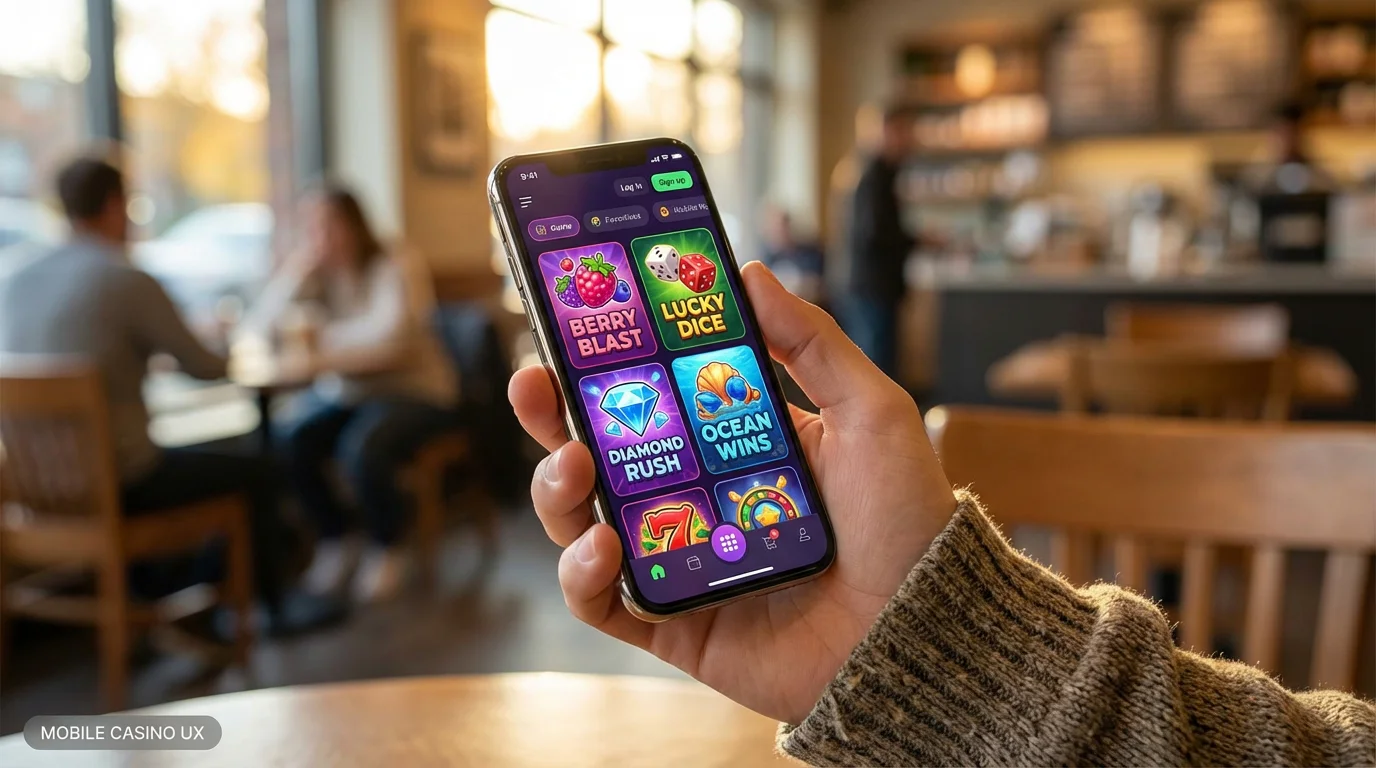
Mobile UX Is the Product — Not an Add-On
More than 70% of UK online gambling sessions happen on a phone. That statistic has been climbing steadily for years, and the implication for non-GamStop casinos is straightforward: the mobile experience isn’t a secondary consideration — it’s the primary product for the majority of players. A casino that works beautifully on desktop but fumbles on mobile is failing its core user base, and in a market where switching costs are nearly zero, that failure translates directly into lost players.
Non-GamStop casinos operate in a competitive environment where the barrier to entry is a web search and a registration form. Players aren’t locked into platforms by self-exclusion mechanisms or loyalty friction — if the mobile experience at one casino frustrates them, they’ll register at another within five minutes. This competitive pressure has driven a genuine evolution in mobile UX across the offshore market over the past two years. The best non-GamStop mobile casinos in 2026 deliver experiences that rival or exceed what UKGC-regulated platforms offer. The worst are still serving desktop layouts scaled down to fit a phone screen, and the experience gap between the two extremes is wider than in any other category of casino comparison.
What “mobile UX” actually encompasses goes beyond whether the casino loads on a phone. It includes the registration flow (how many screens, how many form fields, how biometric autofill integrates), the lobby navigation (how quickly you find and launch a game), the payment interface (how easily you deposit and withdraw on a small screen), the game performance (load times, frame rates, touch responsiveness), the account management experience (balance checks, bonus tracking, verification uploads), and the notification system (how the casino communicates with you through your device). Each of these touchpoints can either streamline the experience or introduce friction, and the cumulative effect determines whether playing on mobile feels effortless or effortful.
The delivery mechanism adds another dimension. Non-GamStop casinos reach your phone through three channels: browser-based responsive websites, native Android apps distributed as APK files outside the Google Play Store, and Progressive Web Apps (PWAs) that blur the line between website and app. Each channel carries different trade-offs in performance, security, and convenience, and the casino’s choice of delivery method tells you something about their technical investment and their approach to mobile players.
This article evaluates the mobile experience at non-GamStop casinos across every relevant dimension — apps versus browsers, performance metrics that actually matter, interface design quality, in-game experience on small screens, and the supporting features that make day-to-day mobile gambling either seamless or tedious. The goal is to give you a framework for assessing any non-GamStop casino’s mobile experience before you commit funds, because the promotional screenshots on their landing page won’t tell you whether their payment flow works with one thumb or whether their live casino stream buffers every thirty seconds.
Native Apps vs Browser Play — The Real Difference
An APK file sitting on your phone isn’t automatically better than a browser tab. The assumption that “app equals better” comes from consumer software where native apps consistently outperform web alternatives — but the casino context is different. Game logic runs on the provider’s server regardless of delivery method, which means the performance-critical processing happens remotely. What the app or browser handles is the interface layer: rendering the lobby, managing navigation, and providing the shell within which games load. The question is whether a native app delivers that shell meaningfully better than a modern mobile browser.
Android APK Sideloading — Process, Risks, and Benefits
Non-GamStop casinos can’t distribute through the Google Play Store. Google’s developer policies prohibit real-money gambling apps from unlicensed operators in most jurisdictions, which means Android users who want a native casino app must download an APK file directly from the casino’s website and install it manually — a process called sideloading.
The installation process requires enabling “Install from unknown sources” in your Android settings (the exact menu location varies by device and Android version). You download the APK, tap the file to install, grant the necessary permissions, and the casino app appears on your home screen. The process takes under two minutes but carries security considerations that browser-based play doesn’t.
The primary risk is provenance. When you install an app from the Play Store, Google has scanned it for malware and verified the developer’s identity. When you sideload an APK from a casino’s website, that verification doesn’t happen. You’re trusting the casino’s download server to deliver an unmodified file, and you’re trusting the APK itself not to request permissions beyond what a casino app legitimately needs. Before installing, check the requested permissions — a casino app should need internet access and possibly storage (for caching). If it requests access to your contacts, SMS, camera, or phone dialer, that’s a red flag for bundled spyware or data harvesting.
The benefits of a native Android app are tangible but modest. App launch is faster than opening a browser and navigating to a URL. Push notifications are more reliable and customisable through a native app. Some apps cache lobby assets locally, reducing load times for the game selection screen. Biometric login (fingerprint or face unlock) integrates more smoothly in native apps than in browser-based sessions. For players who use a single casino regularly, these quality-of-life improvements add up. For players who rotate between multiple platforms, maintaining several sideloaded APKs becomes a management overhead that browser bookmarks don’t require.
iOS and the App Store Wall — Why iPhones Default to Safari
Apple’s App Store policies are stricter than Google’s on gambling apps. Non-GamStop casinos without licences recognised by Apple cannot distribute iOS apps through the App Store, and iOS doesn’t support sideloading APKs the way Android does. The result is that iPhone and iPad users access non-GamStop casinos exclusively through Safari or other mobile browsers.
This isn’t necessarily a disadvantage. Safari on iOS is a capable mobile browser with strong HTML5 support, and most modern casino websites are built to perform well within it. The WebKit rendering engine handles game assets, animations, and streaming content without significant performance penalties compared to a native app. What iOS users lose is the app-like convenience — home screen icon with notification badge, biometric quick-launch, offline access to account information — that Android APK users gain.
Adding a casino’s website to your iOS home screen (through Safari’s “Add to Home Screen” option) partially bridges this gap, particularly if the casino offers a Progressive Web App.
Progressive Web Apps — The Middle Ground
Progressive Web Apps (PWAs) combine website accessibility with app-like functionality. A PWA runs in the browser but can be installed to the home screen, supports push notifications (on Android; iOS support is more limited), caches assets for faster loading, and runs in a standalone window without the browser’s address bar and navigation controls. The result looks and feels like a native app while being delivered entirely through web technology.
For non-GamStop casinos, PWAs solve the distribution problem on both platforms. No sideloading required on Android, no App Store approval needed on iOS. The casino builds one web experience that adapts to both operating systems and delivers app-like functionality without the security concerns of APK downloads. Several established non-GamStop platforms have invested in PWA implementations that load quickly, integrate push notifications, and provide smooth transitions between lobby, games, and account sections.
The limitation is performance ceiling. A well-built PWA is nearly indistinguishable from a native app for casino use cases — lobby navigation, account management, game launching. But in edge cases involving heavy animations, complex live casino interfaces, or low-memory devices, native apps can access hardware resources more efficiently than browser-based applications. For most players on mid-range or better devices, this difference is imperceptible. For players on older hardware or budget phones, it can manifest as occasional lag or longer game load times.
Performance Benchmarks — Load Time, Touch Targets, and Stability
If a game lobby takes more than three seconds to load, most players leave. That threshold comes from general mobile UX research, and it applies to casino sites with the same force as any other mobile experience. Non-GamStop casinos that invest in performance optimisation — server response time, image compression, lazy loading of off-screen assets, CDN distribution — deliver lobby load times under two seconds on a standard 4G connection. Those that don’t can take five to ten seconds to render a usable interface, by which point you’ve already decided whether the casino respects your time.
Game launch time is a separate metric from lobby load time, and it’s often the more revealing one. Clicking a slot tile in the lobby triggers a request to the game provider’s server, which loads the game engine, assets, and configuration into an iframe within the casino’s page. On well-optimised platforms, this takes two to four seconds. On poorly optimised ones — particularly those using multiple intermediary aggregation layers between the casino and the provider — game launch can take eight to twelve seconds, with occasional failures that return you to the lobby without loading the game at all. If a casino’s game launch consistently takes more than five seconds, the infrastructure isn’t meeting current standards.
Touch targets — the tappable areas on screen — are a UX element that’s invisible when done right and infuriating when done wrong. Google’s material design guidelines recommend a minimum touch target size of 48×48 dp (density-independent pixels), which translates to roughly 7-8mm on most screens. Casino interfaces that crowd buttons closer together or use smaller tap areas create misclick risk — hitting “max bet” when you meant to adjust the stake, or tapping “spin” when reaching for the menu. The best mobile casino interfaces space interactive elements generously and use distinct visual boundaries between adjacent controls.
Session stability measures how reliably the casino maintains your connection during play. Disconnections happen on any mobile connection, but how the casino handles them defines the experience. A stable platform reconnects automatically, restores your game state, and preserves any in-progress bet or bonus round. An unstable one drops your session and requires you to log in again, potentially losing your position in a bonus round or multi-hand game. Test stability during your first session by deliberately switching between Wi-Fi and mobile data — a good platform handles the network change seamlessly.
Battery consumption is an overlooked performance metric for mobile casino players. GPU-intensive slots with complex animations, live casino video streams, and crypto wallet integrations all draw significant power. A typical mobile casino session at moderate brightness drains 10-15% of battery per hour on RNG slots and 15-25% per hour on live dealer games (due to continuous video streaming). If you play regularly on mobile, this consumption pattern influences when, where, and how long you can play — a practical constraint that desktop users never encounter. Casinos with efficient rendering engines and optimised asset delivery produce noticeably less battery drain than those running uncompressed animations and high-frequency UI updates.
Interface Design Patterns at Non-GamStop Mobile Casinos
The best mobile casinos borrow UX patterns from fintech, not from desktop gambling sites. The distinction is fundamental. Desktop casino design evolved around wide screens with room for sidebars, multiple navigation levels, and persistent promotional banners. Translating that architecture to a 6-inch screen doesn’t work — the information density overwhelms the display and the navigation becomes a chore. The casinos that get mobile right start from mobile-first design principles: single-column layouts, bottom-anchored navigation bars, swipeable game carousels, and progressive disclosure that shows essential information first and reveals details on demand.
The lobby is where design quality is most immediately apparent. A well-designed mobile lobby presents game categories as horizontal scrollable rows (slots, live casino, table games, new releases) with game tiles large enough to tap accurately and visual enough to identify at a glance. Search functionality is accessible from the top of the screen. Filters — by provider, by game type, by feature (bonus buy, Megaways) — sit behind a single filter icon rather than cluttering the main view. The casino that puts a search bar, three to four category rows, and a “recently played” section above the fold has covered 90% of what players need on their first screen.
Navigation architecture varies more than it should. The strongest pattern places a bottom navigation bar with four to five icons: Home (lobby), Promotions, Deposit, Account, and Menu. This mimics the navigation model players already use in banking apps, social media, and e-commerce — familiar patterns that require zero learning curve. The weaker pattern uses a hamburger menu (three horizontal lines) that hides all navigation behind a single tap, forcing players to open and close a menu for every section change. Hamburger menus reduce visual clutter but increase interaction cost, and in a casino context where players frequently switch between lobby, account, and payment sections, the extra taps accumulate.
Visual hierarchy matters for information-dense pages like bonus terms, payment methods, and account dashboards. The best implementations use card-based layouts with clear headings, adequate whitespace, and progressive disclosure — tap a bonus card to expand its terms, tap a payment method to see its limits and fees. The worst cram everything onto a single scrolling page with uniform text formatting and no visual structure, forcing players to read through walls of text to find the specific information they need.
Dark mode support has become an increasingly relevant UX consideration. Players who gamble on mobile in the evening — which usage data consistently shows is the peak period — benefit from interfaces that reduce eye strain in low-light environments. Some non-GamStop casinos offer a native dark mode toggle. Others default to bright themes with no alternative, which creates glare on maximum brightness and drains battery faster on OLED screens. It’s a small detail, but small details compound across sessions, and the casino that handles evening play comfortably earns more session time than one that doesn’t.
In-Game Experience — How Slots and Live Tables Perform on Mobile
The lobby might look polished, but the actual game is where mobile UX matters most. Once you launch a slot or open a live dealer table, you’re interacting with the game provider’s interface running inside the casino’s wrapper — and the quality of that interaction depends on how well the provider has optimised for mobile and how cleanly the casino integrates the game within its own framework.
Slots on mobile in 2026 have largely converged on a standard interface model. The game fills the screen in either portrait or landscape orientation, with the spin button anchored at the bottom centre, stake controls to one side, and the menu/paytable access to the other. Providers like Pragmatic Play, Hacksaw Gaming, and Push Gaming have refined this layout to the point where their mobile interfaces feel native — the controls are where your thumb expects them, the animations scale cleanly to smaller displays, and the game state information (balance, bet, win) is always visible without obstructing the reel area.
Portrait versus landscape is largely a matter of preference for slots, but certain game mechanics work better in one orientation. Megaways slots with six or more reels display more naturally in landscape, where the additional horizontal space reduces visual compression. Cluster-pay slots like Sweet Bonanza or Reactoonz use square grid layouts that fit portrait mode comfortably. Most modern slots automatically adapt to both orientations, but some lock to one — check during your first spin to avoid discovering a landscape-only game mid-session.
Live dealer games have a more complex relationship with mobile screens. The video stream, betting interface, chat panel, and game history all compete for limited space. Evolution’s mobile interface handles this by layering elements — the video stream occupies the background, betting controls overlay the lower portion, and supplementary information slides in on demand. The result is functional but information-dense, and on screens smaller than 6 inches, it can feel crowded during complex betting phases on roulette or multi-seat blackjack.
Live casino stream quality on mobile depends primarily on your connection rather than your device. A stable 5 Mbps connection delivers smooth HD video with minimal latency. Below that, the stream degrades — first in resolution (dropping from 1080p to 720p to 480p), then in frame rate, then in responsiveness. The practical concern is bet timing: if the stream is delayed by more than a second or two, the dealer may close betting before your interface reflects the current game state. Most live casino providers display a connection quality indicator; if it drops below the acceptable range, switch to RNG games until your connection improves.
Touch responsiveness within games is the silent quality differentiator. A well-optimised game responds to your tap within 50 to 100 milliseconds — fast enough to feel instantaneous. A poorly optimised one introduces 200 to 500 milliseconds of latency between your tap and the on-screen response, creating a disconnected feeling that undermines confidence in the game’s responsiveness. This latency is more noticeable on live casino interfaces where timing matters (closing the betting window on roulette, making hit/stand decisions on blackjack under time pressure) than on slots where each spin is a discrete event.
Account Management, Notifications, and Payment UX on Mobile
Depositing on mobile should take three taps. Withdrawing usually takes more. That asymmetry is partly structural (withdrawals require verification steps that deposits don’t) and partly intentional (adding friction to the withdrawal process increases the probability of cancelled cashouts and continued play). The casino’s payment UX reveals its priorities: a platform that makes deposits frictionless and withdrawals cumbersome has designed its interface to maximise money flowing in, not out.
The best mobile payment experiences at non-GamStop casinos present a clear deposit screen with your preferred payment method pre-selected, an amount input field with quick-select buttons (£20, £50, £100), and a single confirmation tap. For crypto deposits, this means displaying a QR code or copy-to-clipboard wallet address that works seamlessly with mobile wallet apps. For card and e-wallet deposits, it means saved payment methods with biometric confirmation. The entire flow should complete in under thirty seconds.
Withdrawal UX is where the quality differences emerge. A transparent withdrawal process displays available methods, estimated processing times, and any applicable fees on a single screen before you confirm. It shows your pending withdrawal status in the account dashboard and sends a confirmation notification when the withdrawal is processed. A less transparent process buries withdrawal options behind multiple menu levels, doesn’t display processing estimates, and provides no status updates between submission and completion. If you have to contact customer support to learn whether your withdrawal is being processed, the UX has failed.
Account verification (KYC) on mobile is a friction point that’s becoming smoother as casinos adopt mobile-native verification flows. The better implementations let you photograph your ID and proof of address using your phone’s camera within the casino app or site, with real-time feedback on image quality and automatic field extraction. The worse ones require you to email scanned documents to a support address and wait for manual review — a process that feels archaic when your banking app verified your identity with a selfie and a thirty-second video.
Notifications deserve critical attention from a UX perspective. Non-GamStop casinos use push notifications (through native apps or PWAs) and SMS/email to communicate promotions, bonus offers, deposit confirmations, and withdrawal updates. The useful notifications — transaction confirmations, withdrawal processing alerts, bonus expiry warnings — are valuable. The problematic ones — daily promotional pushes, “we miss you” re-engagement messages, escalating deposit bonus offers — are designed to increase play frequency and spending. Review the notification categories your casino sends and disable promotional notifications unless you actively want them. The casino’s notification system is a marketing channel first and a utility tool second.
Swipe, Tap, Spin — Mobile UX Will Only Get More Important
The casino that wins the mobile UX race wins the player. That equation will only become more true as mobile’s share of gambling traffic continues to climb and as player expectations — shaped by the polish of banking apps, delivery services, and social media — continue to rise. A non-GamStop casino in 2026 that delivers a slow, cluttered, or confusing mobile experience is competing against platforms that feel as smooth as checking your bank balance. The bar is no longer “does it work on a phone.” The bar is “does it work as well as everything else on my phone.”
The trajectory is clear in the investments operators are making. Non-GamStop casinos that launched three or four years ago with desktop-first websites have progressively rebuilt their mobile experiences, often from scratch. New platforms launching in 2026 are mobile-first by default — the desktop version is an adaptation of the mobile design rather than the other way around. PWA adoption is growing as operators recognise that the browser-versus-app debate matters less than the quality of the experience delivered through either channel.
For players, this evolution means the mobile experience should be a primary evaluation criterion when selecting a non-GamStop casino — not an afterthought checked after bonuses and game libraries. A casino with a slightly smaller bonus but a significantly better mobile interface will deliver more value per session than one with a massive welcome offer and a payment flow that requires six taps and a page reload to complete a deposit. The friction you experience daily outweighs the one-time benefit of a promotional advantage.
The evaluation framework is practical. Load the casino on your phone before registering. Navigate the lobby, check the game categories, open the payment page, and explore the account section. Time the page loads. Note whether the interface feels designed for your device or adapted from something larger. Try the search function. Check whether the text is readable without zooming. If the casino offers a demo mode, launch a game and assess the in-game controls. This five-minute evaluation tells you more about your future experience than any review site can, because it measures what matters on the device you’ll actually use.
The non-GamStop casinos that understand mobile UX as their core product — not a technical requirement to satisfy — are the ones building sustainable player bases. They’re investing in performance, in interface clarity, in payment flow optimisation, and in the invisible details that separate a platform you tolerate from one you return to. The screen in your pocket is where gambling happens now. The casinos that treat that screen with the attention it demands are the ones worth your attention in return.
Find more mobile guides at mobilecasinonotgamstop. Also read our non-Gamstop casino APK download guide.